By: Sid Peddinti, Esq.
Nonprofit & Tax Lawyer, Researcher, Publisher
Dear friends,
Over the years, having structured over $30 billion in personal and business assets and advised hundreds of high-earning individuals, I’ve noticed one constant: establishing a private 501(c)(3) foundation is one of the single most underutilized wealth preservation, tax mitigation, and legacy strategies available to modern athletes.
Whether you are navigating your first major NIL deal or managing multi-million-dollar professional contract income, setting up your own sports foundation goes far beyond philanthropy. It is a sophisticated legal mechanism to trim taxable income, shield assets from personal liabilities, bypass probate, and build an enduring family enterprise that outlasts your playing career.
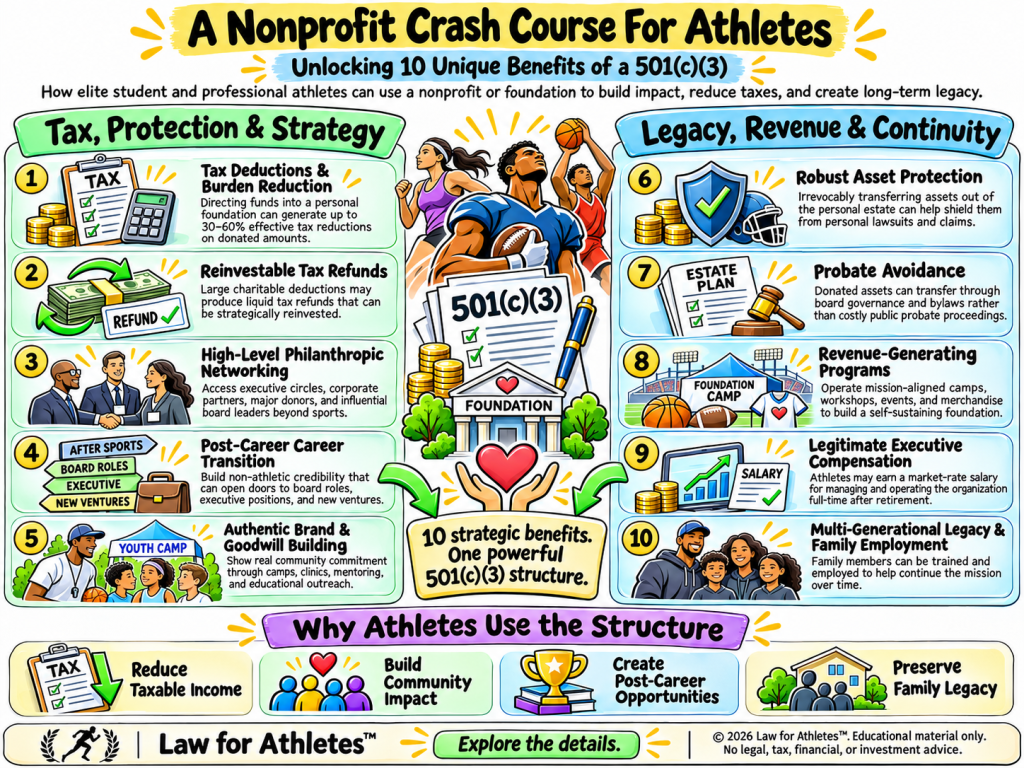
To help you leverage this powerful vehicle, here is a comprehensive guide that walks through the 10 unique legal, tax, and financial benefits of starting your own sports foundation in 2026.
1. Unlocking Significant Tax Advantages Through Strategic Philanthropy
Let’s cut to the chase: the current financial landscape for high-earning athletes is complex. One of the most compelling reasons to establish your own 501(c)(3) nonprofit is the potential for substantial tax benefits. When you contribute funds or assets to your own qualified charitable organization, those contributions are generally tax-deductible. While the exact percentage depends on your Adjusted Gross Income (AGI), the type of asset donated, and current tax laws, it’s not uncommon for high-income earners to see effective tax reductions in the 30-60% range on their donated amounts.
LET ME REPEAT THAT AGAIN IN MORE DEPTH:
501c3 PRIVATE FOUNDATION (Passive nonprofit that engages in investing and grantmaking)
- You can legally reduce your annual tax bill by roughly 30% if you set up a 501c3 private foundation and donate cash into your own foundation
- You can legally reduce your annual tax bill by roughly 20% if you donate assets to your own 501c3 private foundation
501c3 PUBLIC NONPROFIT “CHARITY” (Active public facing and interacting nonprofit that engages in education, programs, sells goods and services, online merchandise, sports programs, etc.)
- You can legally reduce your annual tax bill by roughly 60% if you set up a 501c3 public education, sports, or charitable nonprofit and donate cash to fund your own mission
- You can legally reduce your annual tax bill by roughly 30% if you donate assets to your own 501c3 public charity
This is one of the largest “tax reduction” incentives that the tax code offers.
Why? In the words of Senator Henry Hollis: “For every dollar that a man contributes to these public charities, educational, scientific, or otherwise, the public gets 100 percent.” (Source: Congress: https://www.congress.gov/crs-product/R46178#fn19)
Instead of seeing a larger portion of your income disappear into taxes, you are strategically redirecting those potential tax dollars into a foundation you operate, magnifying your impact, and building a lasting institution.
- Strategic Fund Allocation: You decide where your money goes, directing resources to initiatives that resonate with your personal values and create tangible change.
- Reduced Taxable Income: By making significant charitable contributions, you effectively lower your taxable income, which can reduce your overall tax liability.
- Empowered Giving: This structure allows you to be an active steward of your charitable giving, rather than a passive donor.
2. Maximizing Your Annual Tax Refund for Strategic Reinvestment
Most professional athletes are W2 employees of their respective teams. This means taxes are typically withheld from each paycheck based on estimated annual income and deductions. By establishing and contributing significantly to your own nonprofit, you are creating substantial charitable deductions that may not be fully accounted for in your standard payroll withholding.
The result? A much larger tax refund than you might otherwise receive at the end of the year. This isn’t just “found money”; it’s a strategically generated pool of capital that can be immediately reinvested into personal financial goals, business ventures, or channeled into further charitable endeavors through your foundation.
It provides liquid assets you can deploy for growth, debt reduction, or future planning, essentially accelerating access to capital that would otherwise be tied up or remain with the government for longer.
3. Cultivating a Powerful Network Through Philanthropic Leadership
Beyond the financial mechanics, consider the unparalleled networking opportunities that come with leading a successful nonprofit. As the driving force behind your own foundation, you transition from being merely an athlete to a grant maker, a community leader, and a significant donor. This position opens doors to influential circles far beyond the sports world. You’ll engage with other philanthropists, business executives, policymakers, and community leaders who share your vision.
These aren’t just casual acquaintances; they are deep, purpose-driven connections forged through shared commitment to social impact. Think about the strategic advantage of being in rooms where critical decisions are made and significant resources are deployed-all because you’re leading a cause, not just playing a game. These relationships are invaluable for future endeavors.
- Access to Influencers: Connect with high-net-worth individuals, corporate leaders, and governmental figures actively seeking charitable alignment and collaboration.
- Board and Advisory Roles: Your foundation provides a legitimate platform to interact with diverse boards and advisory councils, expanding your expertise and sphere of influence.
- Collaborative Partnerships: Opportunities to partner with other established organizations, expanding your reach and influence through shared initiatives.
4. Strategizing for a Post-Career Fallback Plan and Monetization: Life After Sports
An athlete’s playing career, whether amateur or professional, is often exhilarating but notoriously short-lived – frequently just 3-4 years for student athletes and 3-5 for professionals. What happens when the cheering stops? The connections you meticulously build through your nonprofit become an invaluable “fall-back” plan.
These aren’t just social ties; they are strategic relationships cultivated with individuals who respect your leadership, business acumen, and commitment to community. These relationships can transition into tangible opportunities for board directorships, investment partnerships, entrepreneurial ventures, or executive roles in various industries. Your nonprofit essentially becomes a launchpad for your next career, allowing you to monetize the trust and credibility you’ve earned long after your athletic prime. It provides a bridge from athletic fame to enduring professional influence.
5. Forging Goodwill, Trust, and Credibility Through Authentic Impact
In today’s interconnected world, an athlete’s personal brand extends far beyond their on-field performance. A well-run nonprofit organization, focused on genuine social, charitable, and sport-related activities like camps, clinics, educational initiatives, or community outreach, is an unparalleled engine for building goodwill, trust, and credibility.
This isn’t about superficial endorsements; it’s about demonstrating authentic commitment to community betterment and using your platform for positive change. This kind of reputation resonates deeply with fans, potential sponsors, and the general public, elevating your personal brand to that of a respected leader and changemaker. This deep well of goodwill serves you throughout your playing career and long into retirement, providing an enduring source of positive public perception and influence that can open doors to new opportunities.
- Enhanced Brand Value: A strong philanthropic arm significantly boosts your marketability and appeal to high-caliber sponsors and partners seeking genuine community alignment.
- Community Engagement: Direct involvement fosters deeper, more meaningful connections with your fan base and local communities, moving beyond simple celebrity appearances.
- Positive Media Narrative: Proactive charitable work provides compelling, positive narratives that transcend sports headlines, building a resilient public image.
6. Robust Asset Protection: Shielding Your Wealth from Personal Claims and Lawsuits
As a lawyer, I cannot stress enough the critical importance of asset protection, especially for high-net-worth individuals like professional athletes who often face heightened scrutiny and potential legal vulnerabilities. When you legally and irrevocably donate assets – whether cash, real estate, intellectual property, or other valuable property – to a properly structured 501(c)(3) nonprofit, those assets are legally removed from your personal estate. This means they are generally protected from personal claims, lawsuits, and creditors.
In the unfortunate event of a personal financial or legal challenge, these donated assets are safeguarded within the charitable entity, ensuring that your philanthropic legacy and the mission of your foundation can continue uninterrupted. This strategy is a sophisticated form of wealth preservation, distinct from personal liability insurance, providing an additional, robust layer of security for a portion of your wealth.
7. Streamlined Succession: Avoiding Probate Actions for Your Donated Assets
Estate planning can be a labyrinthine process, often involving lengthy, public, and costly probate court actions for personal assets. However, assets and cash that have been legally and irrevocably donated to your nonprofit organization are not subject to your personal probate estate. This is a crucial distinction that offers significant advantages. Instead, the continuity of control and management over those assets is typically governed by the nonprofit’s bylaws and the decisions of its independent board of directors. If leadership needs to transition due to retirement, disability, or death, the board can generally make a simple switch or appointment without court involvement, ensuring a smooth, private transition.
This ensures that the foundation’s operations and mission continue seamlessly, preserving your philanthropic intent without the delays and complexities associated with traditional estate administration. It’s an elegant solution for perpetual legacy and uninterrupted impact.
8. Sustainable Impact: Operating Revenue-Generating Programs Within Your Mission
A common misconception is that nonprofits cannot generate revenue. This couldn’t be further from the truth. Your 501(c)(3) can actively run and monetize mission-related programs to sustain itself and expand its impact. Imagine your foundation operating youth sports teams, offering specialized training clinics, hosting educational workshops, or developing mentorship programs. These activities, when directly aligned with your nonprofit’s charitable purpose (e.g., promoting youth development through sports, education, or health), can generate income.
This revenue contributes directly to the foundation’s financial health, reducing reliance on external donations alone and providing a stable funding source. It transforms your nonprofit into a dynamic, self-sustaining entity that continuously fuels its mission and provides valuable services to the community, making its impact more enduring.
- Program Fees: Charging reasonable fees for camps, coaching, or workshops to cover operational costs and generate surplus for mission expansion.
- Merchandise Sales: Selling branded apparel or equipment, with proceeds directly supporting the foundation’s charitable initiatives.
- Event Sponsorships: Securing corporate sponsorships for foundation events, like charity tournaments or galas, linking corporate social responsibility to your mission.
9. A Legitimate Post-Career Income Stream: Taking a Salary from Your Foundation
Here’s a critical point for long-term career planning: you absolutely can take a salary for working and running your nonprofit organization, provided that compensation is “reasonable and comparable to market rates” for the specific services performed. This is not a loophole; it’s a legitimate and often crucial aspect of nonprofit management. For many athletes, managing their foundation becomes their dedicated post-professional career. It provides a meaningful and financially viable pathway to continue contributing to society while earning a respectable income commensurate with their responsibilities and expertise.
The IRS scrutinizes nonprofit compensation closely, so maintaining meticulous records, establishing clear job descriptions, and ensuring your salary aligns with industry standards for similar roles and organizational sizes is paramount. This allows you to leverage your expertise, passion, and network into a new, stable, and impactful career.
10. Perpetuating Your Legacy: Involving and Compensating Family Members
Finally, a nonprofit offers an incredible vehicle for multi-generational legacy building and family involvement. You can hire and train family members to work within the organization, allowing them to take a reasonable, market-comparable salary for their roles, just like any other employee. This means your heirs, even if they aren’t professional athletes themselves, can become active participants in continuing your philanthropic vision and mission.
They can learn valuable leadership, management, and financial skills within a structured environment while carrying forward a meaningful cause that bears your name and reflects your values. This creates a lasting family enterprise, ensuring that the goodwill, connections, and impact you’ve cultivated extend far into the future, becoming a source of pride and purpose for generations to come. It’s a powerful way to engrain values, provide opportunities, and secure the long-term future of your impact.
Closing Thoughts
The decision for a top student-athlete or professional athlete to establish a nonprofit isn’t just a charitable gesture; it’s a shrewd strategic move. From robust tax planning and asset protection to sophisticated career transition and multi-generational legacy building, the benefits are profound and multifaceted.
I strongly advocate for a holistic view of an athlete’s career – one that encompasses not just peak performance but also sustainable financial health, enduring community impact, and a lasting personal legacy. Your nonprofit can be the cornerstone of that comprehensive, forward-looking strategy.
If you’re looking to explore the pros and cons of starting your own sports foundation or nonprofit center, be sure to leave a comment below – we’d love to point you in the right direction.
If you are reading this and you’re in Q4, time is ticking – this can be the biggest tax strategy you have in place for 2026 taxes.
Cheers,
Sid Peddinti, Esq.





Leave a Reply